Is Banana Countable or Uncountable? Grammar Rules Explained

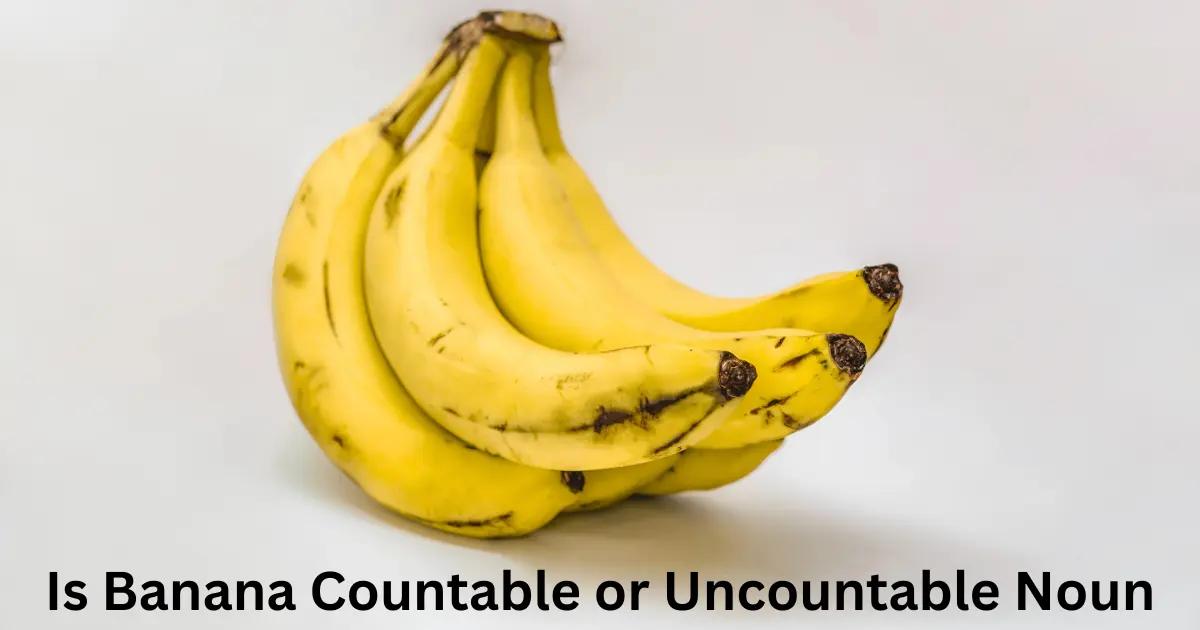
If you’ve ever wondered is banana countable or uncountable, you’re not alone. This question puzzles many English language learners, especially those preparing for exams or trying to master the nuances of English grammar. The straightforward answer is that banana is a countable noun, meaning you can have one banana, two bananas, or many bananas. However, understanding why this is the case—and when exceptions might apply—will help you use this word correctly in every context. In this comprehensive guide, we’ll explore the grammar rules behind countable and uncountable nouns, examine specific examples with bananas, and clarify common mistakes that ESL learners make.
Is Banana a Countable or Uncountable Noun? The Quick Answer
Banana is a countable noun in standard English usage. This means you can count individual bananas as separate, distinct items. You can say “one banana,” “two bananas,” “three bananas,” and so on. The word has both singular and plural forms, which is the hallmark characteristic of countable nouns. When you walk into a grocery store and pick up bananas, you’re selecting individual, countable pieces of fruit that can be numbered.
The question “is banana countable or uncountable” has a definitive answer in most contexts: it’s countable. This classification affects how you use articles (a, an, the), quantifiers (many, few, some), and verb agreement with the noun. Understanding that banana is a countable noun means you’ll know to say “I ate a banana” rather than “I ate banana” (which sounds incomplete in English), and “There are many bananas” rather than “There is much banana.”
The countable nature of banana aligns with how we physically interact with the fruit. Each banana comes in its own peel, has a distinct beginning and end, and can be separated from other bananas. This physical separability is often a good indicator of whether a noun is countable or uncountable in English grammar.
What Are Countable Nouns? Definition and Examples
Countable nouns (also called count nouns) refer to items that can be counted as individual, separate units. These nouns have both singular and plural forms, and you can use numbers directly before them. Countable nouns represent things that exist as distinct, separate entities that can be enumerated one by one.
Key characteristics of countable nouns include:
- They can be preceded by “a” or “an” in the singular form
- They have plural forms (usually formed by adding -s or -es)
- You can use numbers with them (one, two, three, etc.)
- They work with quantifiers like “many,” “few,” “several,” and “a couple of”
- They require singular or plural verb agreement
Common examples of countable nouns include: apple, chair, dog, book, car, student, idea, problem, question, and banana. Notice how each of these can be counted: one apple, two chairs, three dogs. You can visualize each item as a separate, distinct object. When working with countable and uncountable nouns examples, it’s helpful to think about whether you can point to individual instances of the thing being described.
In sentences, countable nouns behave predictably: “I bought three bananas at the market” or “She gave me a banana for breakfast.” The banana countable noun follows standard English grammar patterns that make it easy to use once you understand the basic rules.
What Are Uncountable Nouns? Definition and Examples
Uncountable nouns (also called mass nouns or non-count nouns) refer to substances, concepts, or collections that cannot be counted as separate individual units. These nouns typically represent things that are viewed as wholes, masses, or abstract concepts rather than discrete items. Understanding uncountable noun examples helps clarify why banana doesn’t fit this category.
Characteristics of uncountable nouns include:
- They do not have plural forms (you don’t add -s or -es)
- They cannot be preceded by “a” or “an”
- You cannot use numbers directly with them
- They work with quantifiers like “much,” “little,” “some,” and “a lot of”
- They always take singular verb forms
Common uncountable nouns include: water, milk, rice, bread, cheese, butter, sugar, salt, air, music, information, advice, furniture, and homework. These represent substances or concepts that we don’t typically count in individual units. For instance, is rice countable or uncountable? Rice is uncountable because we don’t say “one rice, two rices”—instead, we measure it (“a cup of rice” or “some rice”).
Similarly, is milk countable or uncountable? Milk is uncountable—you say “some milk” or “a glass of milk,” not “a milk” or “two milks.” The same pattern applies when asking is water countable or uncountable, is cheese countable or uncountable, or is bread countable or uncountable. All of these are uncountable nouns because they represent substances that flow together or are measured rather than counted.
Why rice is uncountable noun becomes clear when you consider that individual grains of rice are too small and numerous to count practically. We treat rice as a mass or substance. This is fundamentally different from banana, which comes in clear, separable units.
Why Banana Is a Countable Noun (With Examples)
The classification of banana as a countable noun stems from several logical and practical factors. First, bananas exist as individual, physically separate units. Each banana has its own peel, its own distinct shape, and clear boundaries that separate it from other bananas. This physical separability is a primary indicator of countability in English grammar.
Second, we naturally count bananas in everyday life. When shopping, you might think “I need to buy five bananas” or “I’ll take a dozen bananas.” This natural counting behavior reflects the countable nature of the noun. You can easily distinguish between one banana and multiple bananas, which is essential for countable nouns.
Here are practical examples demonstrating banana as a countable noun:
- “I ate a banana for breakfast this morning.” (singular with article “a”)
- “She bought six bananas at the grocery store.” (plural with number)
- “There are many bananas in the fruit bowl.” (plural with “many”)
- “Could you give me another banana?” (singular with “another”)
- “Few bananas were left after the party.” (plural with “few”)
- “He ate two ripe bananas after his workout.” (plural with number and adjective)
Notice how the banana grammar rules allow for both singular and plural forms, the use of articles, and the application of numbers. These are all hallmarks of countable nouns. When comparing banana countable or uncountable classifications, the evidence clearly supports countable status.
The countable nature of banana also affects verb agreement. You say “The banana is yellow” (singular verb) but “The bananas are yellow” (plural verb). This subject-verb agreement pattern is characteristic of countable nouns and differs from uncountable nouns, which always take singular verbs.
When to Use ‘A Banana’ vs ‘Bananas’ vs ‘The Banana’
Understanding when to use different articles and forms with the word banana is crucial for proper English usage. The choice between “a banana,” “bananas,” “the banana,” or “the bananas” depends on context, specificity, and whether you’re referring to one or multiple items.
Use “a banana” when referring to one non-specific banana in singular form. This is the indefinite article usage: “I want a banana for a snack” (any banana will do). “A banana” is appropriate when introducing something for the first time or when the specific identity doesn’t matter. You might say, “She packed a banana in her lunch” when it doesn’t matter which particular banana.
Use “bananas” (plural without article) when referring to bananas in general or an unspecified quantity of multiple bananas. For example: “Bananas are rich in potassium” (bananas in general) or “I bought bananas yesterday” (some bananas, quantity not specified). This form works well for general statements and when you’re not being specific about which bananas or exactly how many.
Use “the banana” when referring to one specific banana that both speaker and listener can identify. This is the definite article usage: “The banana on the counter is mine” (a specific, identifiable banana). You also use “the banana” when you’ve already mentioned it: “I bought a banana. The banana was very ripe.”
Use “the bananas” when referring to specific, identifiable multiple bananas: “The bananas I bought yesterday are already brown” or “Please eat the bananas in the fruit bowl before they spoil.” The definite article “the” signals that you’re talking about particular bananas that the listener can identify.
Additional usage patterns include:
- “Some bananas” – an unspecified quantity: “I need some bananas for the recipe”
- “Many bananas” – a large quantity: “There are many bananas at the market today”
- “A few bananas” – a small quantity: “I only need a few bananas“
- “Several bananas” – more than two but not many: “He ate several bananas after the race”
These patterns demonstrate the flexibility of countable nouns like banana. The ability to use various quantifiers and articles is a key feature that distinguishes countable from uncountable nouns.
Common Mistakes ESL Learners Make with Banana
ESL students frequently make specific errors when using banana in English sentences, often because their native languages handle countability differently or because they’re still learning the countable and uncountable nouns rules. Recognizing these common mistakes helps you avoid them and improve your English grammar.
Mistake #1: Omitting the article with singular countable nouns. Incorrect: “I ate banana for breakfast.” Correct: “I ate a banana for breakfast.” In English, singular countable nouns almost always require an article (a, an, or the). You cannot use “banana” alone in singular form without an article in standard English. This is one of the most frequent errors among ESL countable nouns learners.
Mistake #2: Using “much” instead of “many” with countable nouns. Incorrect: “How much bananas do you want?” Correct: “How many bananas do you want?” The quantifier “much” is reserved for uncountable nouns, while “many” is used with countable nouns. Since banana is countable, you must use “many.”
Mistake #3: Forgetting to pluralize when referring to multiple items. Incorrect: “I bought three banana.” Correct: “I bought three bananas.” When you use a number greater than one, the noun must be in plural form. This applies to all countable nouns, including banana.
Mistake #4: Adding plural -s to uncountable nouns by analogy. While this isn’t a mistake with banana specifically (since it is countable), learners sometimes confuse which nouns are countable. They might correctly say “bananas” but then incorrectly say “rices” or “breads” when referring to types. Understanding that is chocolate countable or uncountable, is butter countable or uncountable, or whether meat countable or uncountable helps prevent overgeneralization.
Mistake #5: Using “a” with uncountable nouns. Again, not a banana-specific error, but learners sometimes say “a rice” or “a milk” by analogy with “a banana.” Understanding the distinction helps: you can say “a banana” because it’s countable, but you must say “some rice” or “a glass of milk” because those are uncountable.
Mistake #6: Incorrect verb agreement. Incorrect: “The bananas is yellow.” Correct: “The bananas are yellow.” Plural countable nouns require plural verb forms. This seems obvious but can trip up learners whose native languages don’t mark plurality the same way.
To avoid these errors, practice with countable and uncountable nouns worksheets, take a countable and uncountable nouns quiz, or use countable and uncountable nouns wordwall activities. Many countable and uncountable nouns worksheets with answers are available online to help reinforce these patterns.
Can Banana Ever Be Uncountable? Special Cases Explained
While banana is primarily and overwhelmingly a countable noun, there are rare contexts where it might be treated as uncountable. These special cases are exceptions rather than the rule, and understanding them provides deeper insight into English grammar flexibility.
When referring to banana as a substance or ingredient: In culinary contexts, when banana is mashed, pureed, or otherwise processed into a substance, it can sometimes be treated as uncountable. For example: “This smoothie has banana in it” or “I can taste banana in this bread.” Here, “banana” refers to the flavor or substance rather than individual fruits. However, even in these cases, you could say “This smoothie has bananas in it” (countable), so the uncountable usage is optional and context-dependent.
When discussing banana as a general concept or category: In very general, abstract discussions, banana might appear without articles: “Banana is a popular fruit worldwide.” However, this is more accurately described as a generic use of the countable noun rather than true uncountable usage. The more natural phrasing would be “The banana is a popular fruit” or “Bananas are popular fruits.”
In compound nouns and modifiers: When banana functions as a modifier (like an adjective), it doesn’t follow countable/uncountable rules: “banana bread,” “banana split,” “banana cream pie.” Here, “banana” describes the type of bread, split, or pie rather than functioning as a countable or uncountable noun.
It’s worth noting that some foods can be both countable and uncountable depending on context. For instance, is cake countable or uncountable? It can be both: “I baked a cake” (countable – one whole cake) versus “Would you like some cake?” (uncountable – a portion of cake substance). Similarly, is chocolate countable or uncountable? You can have “a chocolate” (one piece of candy) or “some chocolate” (the substance).
However, banana rarely exhibits this dual nature. Unlike cake or chocolate, banana almost always functions as countable. Even when asking “Can I say bunch of bananas?”—yes, you can, and this phrase actually reinforces the countable nature. A “bunch” is a collective noun that groups multiple countable items together. You’re still counting bananas; you’re just grouping them.
The question “is banana countable or uncountable examples” in various contexts almost always yields countable examples. The uncountable uses are so rare and specialized that for practical purposes, you should treat banana as countable in all standard usage.
Other Fruits: Countable or Uncountable? (Apple, Orange, Grape)
Understanding whether other fruits are countable or uncountable helps reinforce the pattern and clarifies the broader category. The question “is fruit countable or uncountable” itself reveals an interesting distinction: the word “fruit” can be both, but individual fruit names follow specific patterns.
Is apple countable or uncountable? Apple is countable, just like banana. You can have “an apple,” “two apples,” or “many apples.” The same logic applies: apples are individual, separable items with clear boundaries. You say “I ate an apple” not “I ate apple.” The countable nature of apple mirrors that of banana almost exactly.
Orange: Orange is also countable. You can count oranges individually: “one orange,” “three oranges,” “several oranges.” Like banana and apple, orange exists as distinct, separable units. You would say “She peeled an orange” or “There are many oranges in the basket.”
Grape: Grapes are countable, though they’re often discussed in plural form because they grow in bunches. You can say “a grape” (one individual grape) or “grapes” (multiple grapes). “I ate a grape” or “I ate some grapes” are both correct. Despite being small, each grape is a distinct, countable item.
Mango countable or uncountable? Mango is countable. You can have “a mango,” “two mangoes” (or “two mangos”), or “many mangoes.” The pattern continues: individual fruits with clear boundaries are countable nouns.
The word “fruit” itself: Interestingly, “fruit” can be both countable and uncountable. As an uncountable noun, it refers to fruit in general: “Eating fruit is healthy” or “I need to buy some fruit.” As a countable noun, it refers to different types or individual pieces: “This market sells exotic fruits” or “I ate three different fruits today.” However, when you name specific fruits (banana, apple, orange), they are almost always countable.
Here’s a useful pattern: Most individual, whole fruits are countable nouns. This includes:
- Banana, apple, orange, pear, peach, plum, apricot
- Mango, papaya, kiwi, lemon, lime
- Strawberry, raspberry, blueberry, blackberry (even though small, each is countable)
- Watermelon, cantaloupe, honeydew
- Cherry, grape, date, fig
The consistency across fruit names makes this an easy pattern to remember. If you can hold it in your hand as a distinct item, it’s probably countable. This principle applies whether you’re asking is sandwich countable or uncountable (countable – you can have “a sandwich” or “two sandwiches”) or is egg countable or uncountable (countable – “an egg” or “three eggs”).
Practice Exercises: Using Banana Correctly in Sentences
Applying your knowledge through practice helps solidify understanding of banana countable noun usage. Try these exercises to test your grasp of the grammar rules. For each sentence, identify whether the usage is correct or incorrect, and if incorrect, provide the correction.
Exercise 1: Fill in the blank with the correct form
- I need to buy _______ for the fruit salad. (banana/a banana/bananas)
- _______ is rich in potassium and fiber. (Banana/A banana/The banana)
- She ate _______ before her morning run. (banana/a banana/bananas)
- How _______ do we need for the recipe? (much banana/many banana/many bananas)
- There are _______ in the refrigerator. (banana/a banana/some bananas)
Exercise 2: Correct the errors in these sentences
- I ate banana for breakfast.
- How much bananas should I buy?
- The banana in the bowl is ripe.
- She bought three banana at the store.
- Bananas is my favorite fruit.
Exercise 3: Choose the appropriate quantifier
- There are (much/many) _______ bananas in that bunch.
- I only need (a few/a little) _______ bananas for the smoothie.
- We don’t have (much/many) _______ bananas left.
- She bought (several/some amount of) _______ bananas yesterday.
- Could you get me (a/some) _______ banana from the kitchen?
Answers:
Exercise 1: 1) bananas (or “some bananas”), 2) A banana (or “The banana” if specific), 3) a banana, 4) many bananas, 5) some bananas
Exercise 2: 1) “I ate a banana for breakfast.” 2) “How many bananas should I buy?” 3) Correct as is. 4) “She bought three bananas at the store.” 5) “Bananas are my favorite fruit.”
Exercise 3: 1) many, 2) a few, 3) many, 4) several, 5) a
These exercises demonstrate common scenarios where you’ll use banana in countable and uncountable nouns sentences. Practicing with such examples helps internalize the patterns so they become automatic in your speaking and writing.
For additional practice, consider creating your own countable and uncountable nouns sentences using banana and other food items. You might also explore countable and uncountable nouns pdf resources or interactive countable and uncountable nouns wordwall games online to further reinforce these concepts.
Quick Reference Chart: Countable vs Uncountable Nouns
This comprehensive reference chart summarizes the key differences between countable and uncountable nouns, with banana as the primary example for countable nouns. Use this as a quick guide when you’re uncertain about usage.
| Feature | Countable Nouns (e.g., Banana) | Uncountable Nouns (e.g., Rice, Milk) |
|---|---|---|
| Definition | Items that can be counted individually | Substances or concepts that cannot be counted as separate units |
| Singular Form | Yes (banana) | Only singular form exists |
| Plural Form | Yes (bananas) | No plural form |
| Use with “a/an” | Yes (a banana, an apple) | No (not “a rice” or “a milk”) |
| Use with Numbers | Yes (one banana, five bananas) | No (cannot say “three rices”) |
| Quantifiers | many, few, several, a couple of | much, little, a bit of, a great deal of |
| Example Sentences | “I bought three bananas” | “I bought some rice” |
| Verb Agreement | Singular or plural depending on form | Always singular |
| Measurement | Counted directly (1, 2, 3…) | Measured with units (a cup of, a glass of) |
Common Countable Food Nouns: banana, apple, orange, egg, sandwich, cookie, potato, tomato, carrot, onion, strawberry, peach, lemon
Common Uncountable Food Nouns: rice, milk, water, bread, cheese, butter, sugar, salt, flour, meat, fish (when referring to the substance), coffee, tea, juice
Nouns That Can Be Both: Some nouns can function as either countable or uncountable depending on context:
- Chocolate: “a chocolate” (one piece of candy) vs. “some chocolate” (the substance)
- Cake: “a cake” (one whole cake) vs. “some cake” (a portion)
- Coffee: “a coffee” (one cup of coffee) vs. “some coffee” (the beverage in general)
- Paper: “a paper” (one document) vs. “some paper” (the material)
Understanding these patterns helps you navigate the sometimes confusing world of English countability. When in doubt about whether a noun is countable or uncountable, consider these questions: Can you count it as individual items? Does it have a natural plural form? Can you use “a” or “an” before it? If you answer yes to these questions, it’s likely countable, just like banana.
The distinction between countable and uncountable nouns is fundamental to English grammar and affects article usage, quantifiers, verb agreement, and overall sentence structure. Mastering this concept—using concrete examples like “is banana countable or uncountable”—provides a foundation for more advanced English language skills.
Remember that banana is consistently and reliably countable in virtually all contexts. This makes it an excellent example for learning and teaching the concept of countable nouns. Whether you’re an ESL student working through countable and uncountable nouns worksheets with answers, a teacher preparing lessons, or simply someone curious about English grammar, understanding that banana is a countable noun—and why—helps clarify broader grammatical principles that apply across the language.
Frequently Asked Questions
Is banana countable or uncountable?
Banana is a countable noun. You can count individual bananas (one banana, two bananas, three bananas), which is the defining characteristic of countable nouns. However, when referring to banana as a flavor or ingredient in processed form (like “banana in this smoothie”), it can function as an uncountable noun in specific contexts.
Can I say “a bunch of bananas”?
Yes, “a bunch of bananas” is the correct and most common way to refer to multiple bananas still connected on their stem. This collective noun phrase is widely used in English and is grammatically correct. You can also say “bunches of bananas” when referring to multiple groups.
Is fruit countable or uncountable?
The word “fruit” can be both countable and uncountable depending on context. When referring to fruit in general or as a food category, it’s uncountable (e.g., “I eat fruit daily”). When referring to individual pieces or types of fruit, it becomes countable (e.g., “three fruits” or “tropical fruits”). Individual fruit names like banana, apple, and orange are always countable.
What kind of noun is banana?
Banana is a common, concrete, countable noun. It’s common because it refers to a general item rather than a specific name, concrete because it’s a physical object you can touch and see, and countable because you can enumerate individual bananas. It’s also a singular noun that becomes “bananas” in plural form.
Which fruits are uncountable nouns?
Most individual fruit names are countable, but some fruits are typically uncountable when referring to them in bulk or processed form. Examples include “lettuce,” “cabbage” (when referring to the leafy mass), and fruits used as ingredients like “coconut” in “coconut milk” or “lemon” in “lemon juice.” When discussing whether is banana countable or uncountable, remember that the whole fruit is always countable, but banana as a flavor or mashed ingredient can be uncountable.
What are 10 examples of countable nouns?
Ten common examples of countable nouns include: banana, apple, chair, book, car, dog, student, cup, phone, and tree. All of these can be counted individually and take both singular and plural forms. You can say “one banana” or “five bananas,” just as you can say “one book” or “ten books.”
What are 10 examples of uncountable nouns?
Ten common uncountable nouns include: water, rice, milk, bread, cheese, sugar, flour, butter, information, and advice. These nouns cannot be counted individually without using measurement words (like “a glass of water” or “two loaves of bread”). Unlike banana, which is countable, these items are measured rather than counted in their natural form.
Is cucumber an uncountable noun?
No, cucumber is a countable noun, just like banana. You can count individual cucumbers (one cucumber, two cucumbers, etc.). However, when cucumber is chopped or used as an ingredient in phrases like “cucumber in the salad,” it may function as uncountable in that specific context.
Is banana an abstract noun?
No, banana is not an abstract noun—it’s a concrete noun. Abstract nouns refer to intangible concepts like happiness, freedom, or love, while concrete nouns refer to physical objects you can perceive with your senses. Since you can see, touch, taste, and smell a banana, it’s definitively a concrete noun.
What’s the difference between countable and uncountable nouns?
Countable nouns refer to items you can count individually and have both singular and plural forms (banana/bananas, book/books). Uncountable nouns refer to substances, concepts, or masses that cannot be counted individually and typically have only one form (water, rice, information). Countable nouns use “a/an” or numbers before them, while uncountable nouns use quantifiers like “some,” “much,” or measurement words.
You May Also Like
How to Ripen Bananas for Banana Bread: Fast & Natural Methods

Benefits of Banana Bread: Is It Healthy or Just Dessert?